Modern consumers have more choices than ever. A single search for a car, smartphone, laptop, television, appliance, wearable, or smart-home device can produce hundreds of possibilities, each accompanied by specifications, advertisements, promotional claims, and opinions. More information does not necessarily make purchasing decisions easier. In many cases, it makes them more complicated.
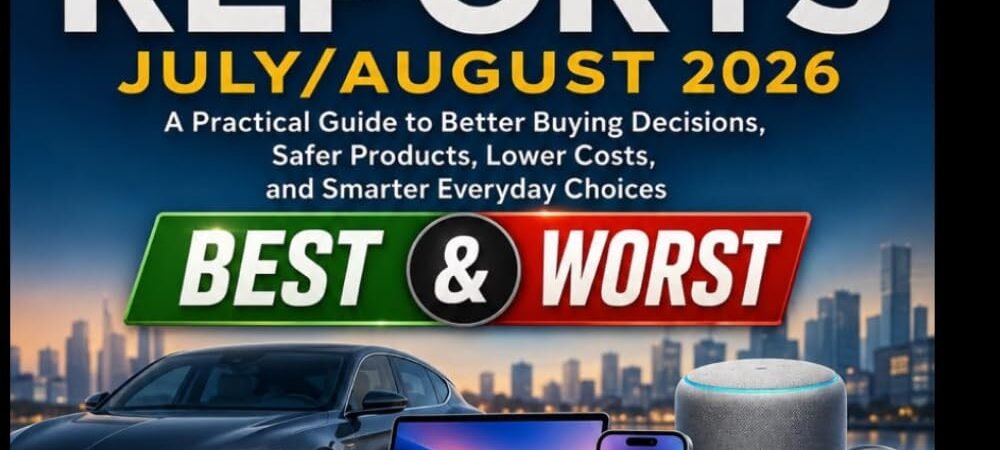
The Smart Handbook to Consumer Reports July/August 2026: A Practical Guide to Better Buying Decisions, Safer Products, Lower Costs, and Smarter Everyday Choices by Jannik Falkenried is positioned as a practical consumer reference focused on evaluating newer cars, consumer electronics, connected technology, and other products arriving around the July-August 2026 period. The published edition information identifies it as an independently published paperback from 2026, with ISBN 9798191486604 and more than 360 pages.
The book’s subject matter covers areas such as electric and hybrid vehicles, luxury and family cars, smartphones, laptops, tablets, wearables, audio technology, smart-home products, and AI-powered consumer devices. Its stated emphasis is on practical considerations such as value, battery life, charging, connectivity, comfort, performance, everyday usability, and longer-term ownership.
It is worth making an important distinction at the outset. Despite the title’s reference to Consumer Reports, this book is not presented in the available bibliographic information as an official Consumer Reports publication. The edition is listed as written by Jannik Falkenried and independently published.
That distinction matters because the actual July/August 2026 issue of Consumer Reports is a separate publication. Consumer Reports describes its own July/August 2026 magazine as containing product ratings, reporting, safety information, and articles covering subjects including automotive safety, food, home safety, and consumer issues.
With that context in mind, this handbook can be approached as a general consumer-buying resource rather than as a replacement for manufacturer documentation, official safety notices, or the original Consumer Reports publication.
Why Consumer Buying Decisions Have Become More Complicated
A modern product page can contain dozens of specifications.
A smartphone may list processor information, camera resolution, display technology, storage, charging speed, wireless standards, artificial intelligence features, and compatibility information. A vehicle may include details about powertrain options, driver-assistance systems, infotainment, range, charging, interior technology, and safety equipment.
The problem is that specifications do not automatically tell a consumer whether a product is appropriate for a particular situation.
A feature can look impressive on paper while being relatively unimportant in everyday use. Conversely, a seemingly minor characteristic can become extremely important after months of ownership.
Consider battery life.
A manufacturer may publish a battery estimate under specific testing conditions. A consumer who travels frequently, uses demanding applications, or spends long periods away from charging may experience a different practical result.
The same principle applies to many categories.
A useful buying process therefore involves asking not only, “What features does this product have?” but also:
- What problem is it supposed to solve?
- Which features will actually be used?
- What limitations should be expected?
- How will the product fit into an existing routine?
- What happens after the initial purchase?
- What are the long-term ownership considerations?
- Are safety or compatibility issues involved?
These questions are central to making informed purchasing decisions.
Key Features of The Smart Handbook
Broad Coverage of Consumer Categories
The book covers a range of consumer categories rather than concentrating on a single product type.
Its published description highlights electric vehicles, hybrids, luxury vehicles, family vehicles, performance cars, smartphones, laptops, tablets, wearables, audio products, smart-home technology, and AI-powered devices.
This broad scope makes the handbook relevant to readers who are researching different types of purchases.
A consumer might use one section to think about a vehicle purchase and later apply similar decision-making principles to a smartphone or home technology purchase.
Focus on Practical Use
The book’s description emphasizes what products can offer in everyday use rather than concentrating exclusively on manufacturer specifications.
That distinction is useful.
A product can have a long specification sheet without necessarily being convenient, comfortable, reliable, or appropriate for a particular household.
Practical evaluation considers the relationship between the product and the person using it.
Attention to Long-Term Ownership
Another stated focus is the difference between initial excitement and longer-term ownership.
This is an important consideration when evaluating technology.
A new product may attract attention because of a new processor, camera system, AI capability, display, or connectivity feature. But after several months, the factors that matter most may be reliability, software support, battery behavior, repair options, compatibility, ergonomics, or ease of use.
Thinking beyond the initial purchase can lead to more realistic comparisons.
Coverage of AI-Powered Consumer Technology
Artificial intelligence has become an increasingly visible part of consumer technology.
The book specifically addresses AI-powered consumer devices and asks whether their features provide meaningful everyday value.
This is an increasingly relevant question.
AI features can perform useful tasks, but the presence of an AI label does not automatically indicate that a feature will be useful to every consumer.
A practical evaluation should consider what the feature actually does, how often it can be used, what services it depends on, and whether it introduces additional privacy or subscription considerations.
Attention to Everyday Usability
The published description refers to areas including battery life, charging, connectivity, comfort, performance, and everyday usability.
These factors often matter after the initial purchase decision.
A device may have impressive technical capabilities but still be inconvenient if its controls are difficult to use, its battery requires frequent charging, or it does not integrate well with the consumer’s existing devices.
How the Handbook Can Be Used
Starting Research Before a Major Purchase
A consumer can use a buying guide at the beginning of the research process rather than waiting until the final stage.
Before opening dozens of product listings, it can be useful to identify the major factors that should be compared.
For example, someone considering a laptop might create a checklist covering:
- Intended workload
- Operating system
- Portability
- Battery requirements
- Display characteristics
- Keyboard and trackpad
- Ports
- Storage
- Memory
- Software compatibility
- Upgradeability
- Support expectations
The list can then be used when comparing specific products.
Creating a Personal Buying Checklist
Different households have different priorities.
A person working primarily from home may care about connectivity, display quality, webcam performance, and ergonomics.
A frequent traveler may place greater emphasis on weight, battery life, durability, and charging convenience.
A family may prioritize reliability, safety, storage, and ease of use.
A buying guide can help readers think in terms of their own priorities rather than simply copying another person’s preferences.
Evaluating Technology Beyond Marketing Language
Marketing often emphasizes new features.
A consumer can respond by asking what each feature means in practical terms.
For example:
“AI-powered camera enhancement” is a description of technology.
A more useful question might be:
“What does this feature actually improve in photographs, and under which conditions?”
Similarly, “fast charging” raises additional questions:
- How fast?
- With which charger?
- Does the charger come with the product?
- What happens to charging performance under different conditions?
- Is special equipment required?
Turning marketing terminology into practical questions can make research more useful.
Comparing Ownership Factors
A purchase does not end when the transaction is completed.
Consumers may need to consider accessories, subscriptions, maintenance, charging equipment, replacement parts, repairs, software support, warranties, and compatibility.
For some products, these ownership factors can influence the overall value more than a small difference in specifications.
Using the Book Alongside Current Sources
Because the book focuses on a specific 2026 release period, readers can use it as one source within a broader research process.
For current products, it is sensible to confirm specifications with the manufacturer and check for updated safety notices, recalls, software information, and compatibility requirements.
For vehicles and other safety-sensitive products, official documentation should receive particular attention.
Applying the Guide to Cars
Cars represent one of the most complicated consumer purchases because they combine transportation, technology, safety, maintenance, comfort, and long-term ownership.
The handbook’s coverage of electric, hybrid, luxury, family, and performance vehicles provides a broad context for considering automotive purchases.
Electric Vehicles
When considering an electric vehicle, consumers may want to examine more than advertised driving range.
Practical questions include:
- How much driving is done each week?
- Is home charging available?
- What charging infrastructure is accessible?
- How long does charging take?
- How does temperature affect real-world use?
- Is the vehicle appropriate for long-distance travel?
- What charging equipment is required?
Range is important, but the charging routine can be equally significant.
Hybrid Vehicles
Hybrid vehicles introduce a different set of considerations.
A consumer may need to understand how the powertrain operates, what type of hybrid system is involved, and whether the vehicle fits their driving pattern.
The balance between electric operation and conventional engine use can vary between models.
Family Vehicles
Families may place greater emphasis on interior space, access, storage, seating flexibility, child-seat compatibility, visibility, safety equipment, and ease of use.
A specification sheet cannot fully communicate how convenient a vehicle will be for daily family routines.
Practical evaluation should therefore include physical use.
Automotive Technology
Modern vehicles increasingly depend on screens and digital interfaces.
Consumer Reports’ July/August 2026 automotive coverage, for example, discusses the potential distraction associated with infotainment systems and recommends paying attention to how easily important controls can be accessed while driving.
This illustrates a broader buying principle: technology should be evaluated not just for what it can do, but for how it affects everyday use and safety.
Applying the Guide to Smartphones
Smartphones are another category where specifications can easily become overwhelming.
Consumers may compare processors, cameras, displays, storage, battery capacities, wireless technologies, AI functions, and software features.
The practical question is which of these characteristics matter to the individual.
Camera Features
A high-resolution camera specification does not tell the entire story.
Consumers may also care about:
- Low-light performance
- Autofocus behavior
- Video stabilization
- Image processing
- Front-camera quality
- Ease of use
- Storage requirements
Someone who primarily photographs documents has different priorities from someone who records frequent video.
Battery and Charging
Battery life depends on usage.
Gaming, navigation, video streaming, photography, mobile data, high screen brightness, and other activities can affect how long a device lasts between charges.
Charging compatibility also matters.
Consumers should check what charging standards are supported and whether accessories are included.
Software and Longevity
A smartphone should not be considered solely on launch specifications.
Software updates, security support, app compatibility, storage requirements, and repairability can affect the useful life of the device.
A phone that remains supported and functional for several years may fit a different purchasing strategy from a device intended for frequent replacement.
Applying the Guide to Laptops and Tablets
Computers require a different type of analysis because performance needs vary dramatically.
A student writing documents does not necessarily need the same hardware as a video editor, software developer, engineer, or professional photographer.
Match Hardware to Workload
Consumers can begin by identifying the applications they expect to use.
Then they can determine the appropriate processor class, memory, storage, graphics capability, and display requirements.
This prevents paying attention to specifications that have little relevance to the actual workload.
Portability Versus Workspace Use
A lightweight laptop can be convenient for travel.
A larger laptop may provide a larger display and more comfortable workspace.
A desktop computer may offer another set of advantages.
The correct category depends on where and how the computer will be used.
Ports and Connectivity
Ports are easy to overlook during a purchase.
A laptop may appear suitable until the owner discovers that an adapter is needed for every external display, storage device, or accessory.
Connectivity should therefore be considered alongside the core specifications.
Applying the Guide to Wearables and Audio Products
Wearables and audio products often depend heavily on comfort and ecosystem compatibility.
Smartwatches
A smartwatch can provide notifications, fitness tracking, communication features, and other functions.
However, compatibility with the user’s smartphone is an important consideration.
Consumers should also think about charging frequency, display visibility, controls, app support, and which features they are actually likely to use.
Fitness and Health Measurements
Wearable measurements can be useful for tracking trends, but they should not automatically be interpreted as medical diagnoses.
Consumers should understand what a device measures, how the measurements are generated, and what limitations apply.
Headphones and Earbuds
Audio products involve more than sound quality.
Important considerations can include:
- Fit
- Comfort
- Battery life
- Charging case design
- Microphone quality
- Noise cancellation
- Device compatibility
- Controls
- Durability
- Connectivity stability
Someone who wears earbuds for several hours a day may place greater importance on comfort than someone who uses them only occasionally.
Applying the Guide to Smart-Home Technology
Smart-home devices can make everyday tasks more convenient, but they also introduce additional layers of technology.
Consumers should consider:
- Wi-Fi requirements
- App compatibility
- Voice-assistant compatibility
- Account requirements
- Subscription requirements
- Data privacy
- Security
- Software updates
- What happens if internet connectivity is lost
A connected product may be useful, but consumers should understand what happens when the connected services are unavailable.
For example, if a smart device requires cloud connectivity for a particular function, its usefulness may change during an internet outage.
Evaluating AI Features in Consumer Products
AI is increasingly used in phones, computers, cameras, wearables, smart-home devices, and vehicles.
The presence of AI can make a product sound more advanced, but the more useful question is whether the functionality addresses a real need.
Ask What the AI Actually Does
Instead of focusing on the label, identify the specific task.
Does the feature:
- Summarize information?
- Translate text?
- Improve photographs?
- Assist with writing?
- Organize information?
- Recognize objects?
- Automate repetitive tasks?
- Provide voice interaction?
A concrete description is more informative than a general claim about artificial intelligence.
Consider Privacy
AI features may process information through the device, an application, or an online service.
Consumers should review relevant privacy documentation and understand what information is collected and how it is handled.
Consider Connectivity Requirements
Some AI functions may work locally, while others depend on cloud services.
Understanding this distinction can help consumers set realistic expectations.
Consider Long-Term Availability
Software features can change.
Some services may require subscriptions, accounts, or continued support.
This makes long-term software availability another factor worth considering.
Important Things to Consider
The Title Should Not Be Confused With the Official Consumer Reports Magazine
This is one of the most important contextual points about the book.
The available bibliographic listings identify The Smart Handbook to Consumer Reports July/August 2026 as a book by Jannik Falkenried and an independently published edition.
Consumer Reports itself publishes a separate July/August 2026 magazine issue. Its official archive identifies that issue and describes its content, including investigative reporting, product information, and consumer advice.
Readers should therefore distinguish between the independently published handbook and the official Consumer Reports publication.
Product Information Can Change
Technology changes rapidly.
A specification that is accurate at publication may later change because of software updates, revised accessories, new versions, discontinued products, or manufacturer changes.
Before purchasing, consumers should verify current information.
Safety Information Should Come From Appropriate Authorities
A general consumer book can help readers understand product categories, but safety decisions should also be checked against current manufacturer instructions, recall notices, and relevant government or regulatory sources.
This is particularly important for vehicles, electrical products, children’s products, appliances, and other equipment where incorrect use could create safety risks.
Do Not Treat General Guidance as Individual Advice
Consumer guidance can help structure research, but it cannot account for every individual’s circumstances.
A product that makes sense for one household may not suit another.
The reader’s budget, location, existing equipment, technical ability, transportation needs, family situation, and intended use all matter.
Avoid Focusing Only on the Initial Purchase
The total ownership experience can include:
- Accessories
- Replacement parts
- Maintenance
- Repairs
- Subscriptions
- Charging
- Software support
- Insurance
- Installation
- Energy use
A lower initial purchase cost does not necessarily mean lower overall ownership costs.
Comparing General Categories of Consumer Buying Resources
General Buying Guides
General buying guides explain categories, features, and purchasing considerations.
They can be useful early in the research process.
Their main strength is breadth, although readers may still need current product-specific information.
Product Reviews
Individual reviews focus more closely on particular products.
They can provide detailed observations, but readers should distinguish between documented testing, personal opinion, sponsored content, and promotional material.
Manufacturer Information
Manufacturer documentation is particularly useful for exact specifications, compatibility, warranty conditions, installation instructions, and operating requirements.
It should be checked before purchasing or using a product.
Official Safety and Recall Information
Government agencies and official safety organizations provide information about recalls and safety requirements.
These sources are especially important when purchasing products where a safety defect could create significant risk.
Consumer Publications
Consumer publications may provide broader testing, research, comparisons, and reporting.
Readers should verify which publication they are actually consulting and whether the information applies to the product model and market they are considering.
Building a Smarter Buying Process
A practical buying process can be divided into several stages.
Stage One: Define the Need
Start with the problem.
Why are you buying the product?
If the answer is unclear, it may be difficult to determine which features actually matter.
Stage Two: Set Priorities
Separate essential requirements from desirable features.
For example:
Essential: Compatible with existing devices.
Important: Good battery life.
Optional: Advanced AI functions.
This prevents attractive extras from overshadowing basic requirements.
Stage Three: Research Categories
Understand the different product categories before selecting a specific model.
This is particularly useful for cars, laptops, appliances, cameras, and smart-home equipment.
Stage Four: Compare Alternatives
Create a simple comparison table.
The table does not need to contain dozens of specifications.
Focus on the factors that directly relate to your objectives.
Stage Five: Verify Current Information
Check the manufacturer’s current product page and relevant official information.
Confirm the exact model number.
This matters because similar product names can refer to different generations or configurations.
Stage Six: Consider Ownership
Ask what happens after the purchase.
Will you need accessories?
Is a subscription involved?
How often will it require charging or maintenance?
Is support available?
Stage Seven: Make the Decision
Once the important information is collected, make a decision based on your priorities rather than trying to find an imaginary product with no disadvantages.
Every product involves trade-offs.
Understanding those trade-offs is more useful than expecting perfection.
Frequently Asked Questions
What is The Smart Handbook to Consumer Reports July/August 2026?
It is a 2026 independently published consumer guide by Jannik Falkenried that discusses cars, consumer electronics, smart-home technology, AI-powered devices, and practical buying considerations. Bibliographic listings identify ISBN 9798191486604 and a paperback edition of more than 360 pages.
Is this book an official Consumer Reports publication?
The available bibliographic information identifies the book as written by Jannik Falkenried and independently published. It should therefore be distinguished from the official Consumer Reports July/August 2026 magazine issue published by Consumer Reports.
What types of products does the handbook discuss?
Its published description mentions electric and hybrid vehicles, luxury and family vehicles, performance cars, smartphones, laptops, tablets, wearables, audio technology, smart-home products, and AI-powered consumer technology.
Is the handbook focused only on specifications?
No. Its stated approach emphasizes practical considerations such as value, battery life, charging, connectivity, comfort, performance, everyday usability, and long-term ownership.
Can the guide help with smartphone purchasing?
The book’s technology coverage includes smartphones, and its broader decision-making approach can be applied to factors such as battery life, connectivity, usability, features, and long-term ownership.
Does it discuss artificial intelligence?
Yes. The published description specifically mentions AI-powered consumer technology and consideration of whether AI features provide practical value.
Should readers rely only on a buying guide when purchasing a safety-sensitive product?
No. Current manufacturer information, applicable safety requirements, and official recall information should also be checked when relevant.
Why is long-term ownership important?
Some costs and limitations only become apparent after the initial purchase. Maintenance, subscriptions, accessories, charging, repairs, software support, and compatibility can all affect the practical experience of owning a product.
How should consumers evaluate AI features?
Consumers can start by identifying what the feature actually does, how often it might be useful, whether it requires an internet connection or subscription, what information it processes, and whether the functionality is likely to remain supported.
Can a product with more features be a better fit?
Not necessarily. Additional features can be useful, but they can also increase complexity, cost, power consumption, or dependence on software and services. The appropriate feature set depends on the user’s needs.
How can consumers avoid marketing hype?
Translate promotional language into specific questions.
Instead of accepting “advanced technology,” ask what the technology actually does. Instead of focusing only on “fast charging,” investigate charging requirements and real-world usage. Instead of focusing on an “AI-powered” label, identify the specific AI functions.
What is the official July/August 2026 Consumer Reports issue about?
The official Consumer Reports July/August 2026 issue includes topics such as automotive distraction, store-brand food, rotisserie chicken, emergency home safety, and consumer-related reporting.
Can this handbook replace professional or official information?
No. It can serve as a general consumer research resource, but product-specific manufacturer information and official safety or regulatory information remain important sources when making purchasing decisions.
Conclusion
Making a thoughtful purchase in 2026 often requires more than comparing prices or reading a list of specifications. Consumers have to consider usability, compatibility, safety, long-term ownership, software support, connectivity, maintenance, and whether new features provide meaningful value.
The Smart Handbook to Consumer Reports July/August 2026 approaches these questions across a broad selection of consumer categories. Its published description covers electric and hybrid vehicles, family and luxury cars, smartphones, laptops, tablets, wearables, audio equipment, smart-home technology, and AI-powered devices, with particular attention to practical use and longer-term ownership.
The handbook can be viewed as a starting point for organizing consumer research. It can encourage readers to move beyond advertising language and ask more practical questions: What problem does this product solve? Which features matter to me? What limitations should I understand? What will ownership involve after the initial purchase?
At the same time, readers should understand the publication context. The available edition information identifies the book as an independently published work by Jannik Falkenried, rather than an official Consumer Reports publication. The official Consumer Reports July/August 2026 magazine is a separate publication with its own reporting, testing, and consumer content.
For current purchasing decisions, a good research process should combine general guidance with up-to-date product information. Manufacturer specifications, current manuals, official safety notices, recall databases, and other reliable sources can help confirm details that may change over time.
Ultimately, smarter buying is not about finding a product with no disadvantages. It is about understanding your own needs, recognizing the trade-offs, verifying important information, and choosing according to the factors that matter most in your particular situation.